When capable people start to struggle
And why the usual explanations don’t quite fit
Many capable, experienced people reach a point at work where things start to feel off.
Not dramatically broken.
Not obviously wrong.
Just… heavier.
Decisions feel riskier.
Confidence fluctuates.
Conversations become careful.
Pressure lingers even when performance is strong.
The explanations that usually follow are familiar:
- confidence issues
- imposter syndrome
- resilience
- mindset
- engagement
They sound reasonable.
They are often well-intentioned.
But they frequently miss what is actually happening.
A different starting point
Positive Work Ways® begins from a simple premise:
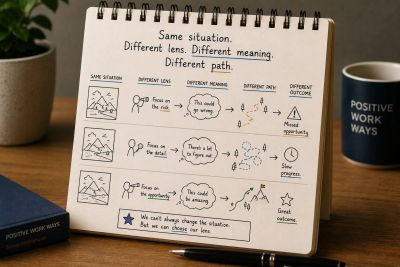
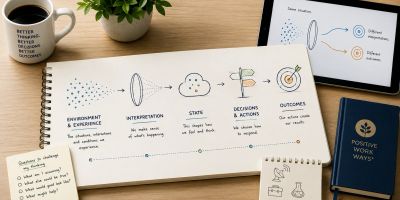
Behaviour follows brain state.
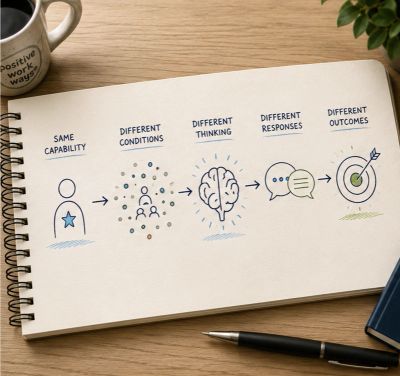
Brain state is shaped by conditions.
And conditions are designed.
This means many struggles at work are not personal flaws or capability gaps. They are predictable responses to how work is structured, led, and experienced.
When pace increases, visibility rises, priorities blur, or consequences feel uncertain, the brain adapts.
Thinking narrows.
Self-monitoring increases.
Risk feels higher.
That shift is not weakness.
It is responsiveness.
What We mean by “state”
Throughout this site, the word state is used deliberately.
State is not mood.
It is not personality.
And it is not a trait someone either has or lacks.
State describes the operating condition of the brain in a given moment — and it shapes what becomes possible.
When state is stable, people tend to have:
- capacity to think clearly and hold complexity
- attention that can widen rather than narrow
- flexibility to adapt and problem-solve
- perspective that keeps risk in proportion
When state is destabilised:
- capacity shrinks
- attention narrows
- flexibility drops
- risk feels higher, even when it hasn’t objectively changed
This is why the same person can appear confident in one context and hesitant in another.
It isn’t inconsistency.
It’s context.

Why work shifts state so reliably
.png/:/rs=w:400,cg:true,m)
Workplaces are powerful state-shaping environments
State commonly shifts at work due to:
- pace - work moving faster than sense-making
- exposure - increased visibility or scrutiny
- uncertainty - unclear priorities, shifting expectations
- consequence - unpredictable or disproportionate cost of error
These are not “soft” factors. They are performance conditions.
And when they are poorly designed or unmanaged, behaviour changes - even in highly capable people.
What Positive Work Ways® offers
A brain-state-led approach to leadership, work design, and performance.
Positive Work Ways® is a brain-state-led approach to leadership, work design, and performance.
It does not focus on fixing people. It focuses on stabilising the conditions that allow people to think, decide, and perform well.
The work integrates:
- neuroscience-informed understanding of brain state
- solutions-focused practice
- real-world organisational experience
The aim is simple:
Create conditions where capability can actually show up.
One important clarification
This work is not about lowering standards
This work is not about lowering standards, avoiding challenge, or removing accountability.
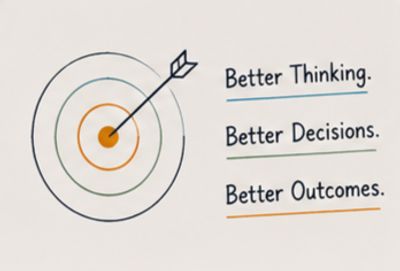
In fact, it does the opposite.When state is stabilised:
- thinking improves
- judgement sharpens
- accountability becomes clearer
- performance becomes more consistent
This is not about coping better.It’s about designing work so people don’t have to compensate constantly.
If this already feels familiar
A sign you’ve already been sensing something
That’s usually a sign you’ve been sensing something important but haven’t had the language for it.
You don’t need to fix yourself to use this work.
You don’t need another framework to diagnose your personality.
You need a clearer way of seeing what work is asking of people — and what it is quietly training them to do in response.
That’s what this site is here to support.
Contact Us
strategic leadership & workforce development
Positive Work Ways
email suppport@positiveworkways.com phone: 07724 666046
